

Knowledge Hub – Strategy Meets Psychology
Welcome to our Knowledge Hub — Curated tools, insights, and success stories to help you lead with confidence.
Knowledge Hub – Strategy Meets Psychology
Welcome to our Knowledge Hub — Curated tools, insights, and success stories to help you lead with confidence.
Featured Insight
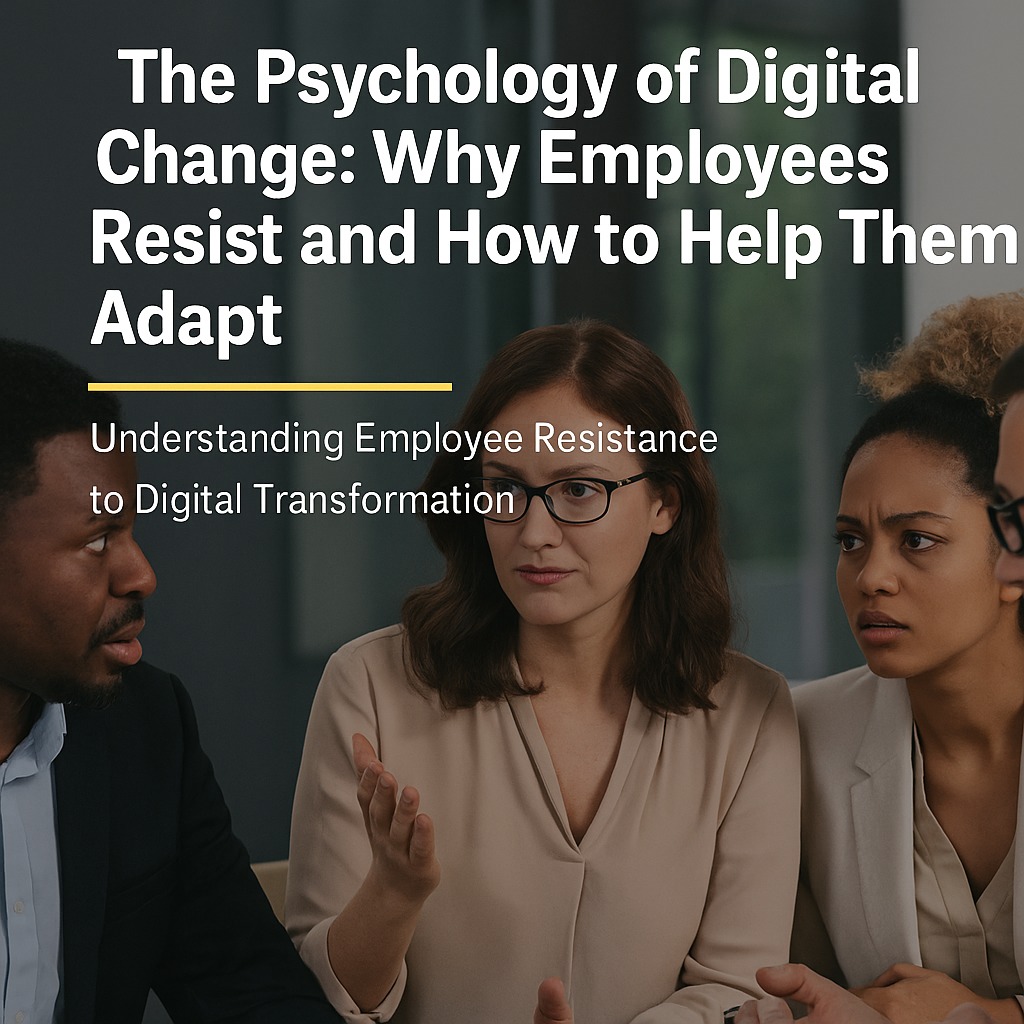
Understanding Resistance to Digital Transformation
Digital transformation promises agility, innovation, and efficiency. Yet, when new technologies arrive, many organizations are surprised by the resistance they face from within.
Change isn’t just technological. It’s psychological!
From fear of job loss to the discomfort of learning unfamiliar tools, employees often experience anxiety, skepticism, and disengagement when change is introduced. Understanding these reactions is the first step toward successful digital adoption.
Key Psychological Barriers to Digital Change
When systems change, employees often feel disempowered. The tools they’ve mastered are replaced, and their routines are disrupted.
Tip: Involve employees early in the process. Give them a voice and ownership.
New technology can trigger self-doubt. Will I be able to learn this? What if I fail?
Tip: Offer training and safe spaces for experimentation.
For long-tenured employees, digital change can feel like a personal invalidation: "The old way no longer matters."
Tip: Honor legacy contributions. Show how new tools build on past success.
When change feels arbitrary or disconnected from day-to-day work, it is met with apathy.
Tip: Tie digital change to purpose. Make it matter to people, not just the bottom line.
From Resistance to Readiness: A Psychology-Backed Approach
To move from resistance to readiness, organizations must view digital change not only as a technical rollout but as a human journey.
Final Takeaway
Digital change will always be part of the future of work. But without psychological safety and thoughtful leadership, transformation efforts fall flat.
To succeed, organizations must not only manage change. They must design it with the human brain in mind.
At S Y Consulting, we specialize in psychology-driven change management. We help organizations design people-friendly, future-proof transformation strategies—blending behavioral science with digital innovation. From culture diagnostics to AI adoption, our approach ensures your workforce doesn’t just accept change—they lead it.
🌍 Source: S Y Consulting | June 2025
As AI continues to transform the workplace, trust has become the linchpin of effective leadership. It’s no longer enough to implement powerful tools — leaders must ensure people feel secure, valued, and engaged while working alongside these technologies.
In an environment where change feels constant and digital tools often outpace human comfort zones, trust isn’t a soft skill — it’s a strategic imperative.
Here are three leadership strategies to build trust in the AI era:
🔹 1. Communicate the “Why” Behind AI
Uncertainty erodes trust. When AI tools are introduced without clarity, employees may interpret the shift as a threat — to their roles, relevance, or autonomy. Leaders must demystify AI by openly explaining:
Transparent storytelling creates psychological safety — a foundation for trust.
🔹 2. Involve People in the Process
Change done “to” people breeds resistance. Change done “with” people invites trust.
Involving people in early stages — it communicates respect. People are more likely to trust what they help build. Encourage cross-functional input, listen to frontline concerns, and treat feedback as data, not disruption.
🔹 3. Show (Not Just Tell) Ethical Leadership
Trust in AI is trust in leadership. Leaders must model ethical, human-centered decision-making in everything from how data is used to how success is measured. This includes:
When leaders anchor their AI strategy with focus, they prove that technology is a tool — not a replacement for human judgment.
💬 Final Thought
In the age of intelligent machines, trust remains profoundly human.
As you lead transformation, remember: people don’t fear AI — they fear being left behind.
Build with empathy. Lead with clarity. Trust will follow.
— At S Y Consulting, we help organizations navigate AI change with psychological insight and strategic clarity. From employee engagement frameworks to ethical AI rollout strategies, we partner with leaders to make transformation human-centered and future-ready.
The AI-Ready Workforce – 5 Capabilities Every Organization Should Develop
🔹 By S Y Consulting | July 2025
As AI accelerates how we work, the question for leaders is no longer whether to adapt—but how to prepare their people to thrive alongside intelligent systems.
At S Y Consulting, we believe that successful AI integration starts with building workforce capability—not just digital infrastructure.
Here are 5 foundational capabilities every organization should be investing in now:
💬 Why It Matters:
Without these foundational capabilities, even the best AI tools will struggle to scale. The most AI-ready organizations are not just digitally mature—they are psychologically prepared, culturally agile, and people-led.
🔹 At S Y Consulting, we help leaders embed these capabilities through behavior-driven strategies, learning pathways, and cultural diagnostics.
🔹 Explore here how we can support → www.syconsultingglobal.com
Psychological Safety: The Missing Link in Tech-Driven Change
🔹 Source S Y Consulting | July 2025
In today’s race toward AI adoption and digital transformation, organizations are pouring resources into new platforms, algorithms, and automation tools. That investment is important—but it’s not enough.
What often gets overlooked is what we call the invisible infrastructure of successful change:
Psychological safety.
At S Y Consulting, we believe that no amount of cutting-edge tech can make up for a culture where people feel unsafe to speak, try, fail, or learn in public.
🔹 When the Tech Arrives Before the Trust
AI brings efficiency—but it also brings uncertainty.
It challenges identities.
It forces people to rethink their roles.
It raises ethical questions they may be afraid to ask.
And yet, too often, these emotional and cultural dynamics are seen as “soft” or secondary to the strategy. In reality, they’re central.
Because in psychologically unsafe environments:
Innovation can’t breathe in a climate of fear.
🔹 Psychological Safety Isn’t a Perk—It’s a Performance Driver
Leaders who create psychological safety:
That’s not just good culture, it’s good business.
At S Y Consulting, we don’t just focus on systems readiness.
We focus on people’s readiness that starts by building environments where speaking up is rewarded, not punished.
🔹 The Takeaway
As organizations build their AI roadmaps, here’s a strategic question every leader should ask:
“Do our people feel safe enough to shape this change—or are they just surviving it?”
If your culture can’t hold discomfort, it won’t hold transformation.
The future of work demands more than smart machines.
It demands brave leadership and cultures where human intelligence can thrive—alongside artificial intelligence.
Psychological Safety ≠ Comfort. Let’s Clear That Up.
🔹 Source: SY Consulting | July 2025
It’s one of the most common misconceptions we see in leadership teams:
“We want people to feel safe, so let’s avoid too much conflict, pushback, or discomfort.”
But here’s the truth:
Psychological safety isn’t about comfort.
It’s about courage.
It’s not about protecting people from challenge.
It’s about creating a space where people can speak honestly—even when it’s hard.
What’s the difference?
🔹 Comfort is:
🔹 Psychological safety is:
If everyone’s comfortable, but no one’s disagreeing, questioning, or experimenting…
That’s not safety.
That’s politeness.
And it can be just as dangerous as fear.
Where teams go wrong
We’ve worked with teams who say,
“We’re like a family. Everyone gets along. No drama.”
But when we dig deeper, no one’s challenging leadership.
No one’s asking hard questions.
No one feels safe enough to fail out loud.
That’s not trust. That’s tension avoidance.
What real psychological safety feels like:
It’s not always comfortable.
But it’s real.
And that’s where growth happens.
At S Y Consulting, we help organizations build cultures that are not just nice—but brave.
Because real change doesn’t come from comfort.
It comes from trust, honesty, and challenge—done right.
Ready to build real safety in your team or culture?
Let’s talk.
Leadership behaviours that reduce stress (without requiring big initiatives)
🔹 By S Y Consulting | July 2025
When workplace stress rises, the usual response is to add something new: a well-being program, a resilience session, a policy update.
Yet stress rarely comes from what organisations lack.
More often, it comes from how leadership shows up day to day.
At SY Consulting, we see this repeatedly: teams under pressure not because the work is impossible, but because leadership behaviours unintentionally amplify strain. The most powerful stress reducers are not initiatives. They are micro-behaviours, often invisible to those enacting them.
Here are a few leadership shifts that consistently make a difference.
Uncertainty is one of the strongest drivers of stress. When priorities shift frequently, decisions arrive without context, or silence replaces clarity, people fill the gaps with worry.
Leaders reduce stress when they create a sense of predictability:
This doesn’t remove uncertainty but it makes it manageable. People cope better when they understand the terrain they are navigating.
Stress increases when people are asked to act without understanding the rationale behind decisions. When the “why” is missing, teams second-guess, overthink, or disengage quietly.
Leaders who reduce stress don’t over-explain but they do:
This simple behaviour builds trust and reduces the cognitive load of trying to interpret leadership intent.
In many organisations, urgency has become the default tone. Everything is “ASAP”. Everything feels critical.
The result? Teams remain in a constant state of alert, which erodes focus and decision quality over time.
Stress-aware leaders are deliberate with urgency. They signal what truly matters now, and what can wait. They understand that pace is not the same as pressure and that calm clarity often drives better outcomes than constant acceleration.
Stress rises when people feel they must be certain, polished, or correct before speaking. In these environments, thinking becomes private, and concerns surface late, if at all.
Leaders reduce stress when they:
This isn’t about lowering standards. It’s about lowering the fear cost of contributing.
Perhaps the most underestimated factor in workplace stress is leader self-regulation.
Tone, pace, and emotional reactions travel quickly through teams. When leaders operate in visible overload, teams absorb it. When leaders slow down, prioritise thoughtfully, and respond rather than react, they create psychological steadiness around them.
Stress is not only experienced individually.
It is shaped socially.
Final reflection
If stress levels are rising in your team, it’s worth pausing before adding another initiative.
Instead, ask:
Stress is not reduced by big gestures alone.
It is influenced, quietly and consistently, by leadership behaviour.
🔹 At S Y Consulting, we support organisations in building leadership capability that understands stress not as a wellbeing issue, but as a strategic factor in performance and change.
🔹 Interested in exploring this further? Let’s talk!
3 Early Warning Signs of Burnout Leaders Often Miss
🔹 By S Y Consulting | January 2026
Burnout rarely shows up as collapse, emotional outbursts, or people saying “I can’t cope anymore.”
More often, it develops quietly, hidden behind behaviors that are misread as commitment, resilience, or professionalism. This is why burnout is frequently detected late, when performance has already declined or disengagement has set in.
From an organizational psychology perspective, burnout is less about sudden overload and more about prolonged, unaddressed strain. Leaders play a critical role in spotting it early, but only if they know what to look for.
Here are three early warning signs that are commonly missed:
One of the earliest signs of burnout is social withdrawal.
People speak less in meetings, contribute selectively, and keep their heads down.
This is often misinterpreted as:
In reality, it can signal emotional conservation - a coping response where individuals reduce interaction to preserve limited energy. When left unnoticed, this withdrawal gradually erodes collaboration, trust, and psychological safety.
Burnout does not always show up as lower output.
In fact, effort often remains high.
What changes first is curiosity:
When people stop wondering, experimenting, or contributing beyond what is required, it’s often a sign of cognitive and emotional depletion. This signal is subtle, and frequently overlooked, yet it is one of the most reliable early indicators.
Burnout is not always visible as frustration or stress.
In many cases, it appears as emotional neutrality.
People seem:
This emotional flattening is a protective response, not disengagement by choice. It reflects a narrowing of emotional range that allows individuals to keep functioning, but at a significant personal cost.
Why Leaders Miss these Signals
These warning signs are easy to miss because they don’t disrupt performance immediately. They don’t trigger alarms. They often look like people “coping.”
Yet burnout prevention is not about reacting to breakdowns.
It is about recognising early patterns of strain and responding before capacity is depleted.
A Leadership Reflection
Instead of asking, “Is this person still performing?”
A more useful question is, “What has changed in how they are engaging?”
Early awareness creates space for adjustment - in workload, expectations, pacing, and support.
🔹 At S Y Consulting, we help leaders build the capability to recognize early stress signals and respond thoughtfully - before burnout becomes visible, costly, and entrenched.
🔹 Interested in exploring this further? Let’s talk!
Weekly Insight Spotlights
a curated space for forward-thinking leaders who want to shape the future of work, culture, and change.
Beyond the Buzz: GenAI’s Everyday Impact at Work
Source: Harvard Business Review | April 2025
As the AI hype settles, a new question emerges: how are real people actually using GenAI at work?
According to Harvard Business Review, the answer goes beyond automation — it's about augmented intelligence, personal coaching, content creation, and continuous feedback. It’s a window into the real-world human-AI relationship and a helpful guide for organizations still figuring out how to use GenAI responsibly.
What stood out to me:
🔹 Employees are using GenAI to summarize meetings and emails
🔹 Managers are leveraging it for feedback loops and performance support
🔹 Teams are experimenting with GenAI for creativity, not just productivity
This shift reflects what I see in my own consulting work: success with AI starts with culture, not code.
📖 Full Insight: Read the full article ↗
https://hbr.org/2025/04/how-people-are-really-using-gen-ai-in-2025
🔹 Spotlight Insight: Making Sense of AI Limitations
🔹 Source: arXiv | February 2025
Exploring how human interpretation—not just infrastructure—defines successful AI adoption.
This peer-reviewed study reveals a key truth: AI readiness isn’t just technical—it’s psychological. Employees make sense of AI through experience, trust, and cultural cues. The absence of psychological safety can stall even the best systems.
🔹 Key Takeaways:
🔹 SYC’s Perspective:
At S Y Consulting, we help organizations decode these invisible barriers—bridging behavioral science with tech strategy. Because tools can be deployed overnight, but trust takes intention.
Want to explore how your team interprets change? Contact us then, Lets talk!
🔹 Full Research Article: arXiv | Making Sense of AI Limitations
Link → https://arxiv.org/abs/2502.15870
Why AI Demands a New Breed of Leaders
Source: MIT Sloan Management Review | April 2025
AI isn’t just reshaping technology—it’s redefining leadership.
Today’s leaders need more than business acumen. They need:
🔹 Emotional intelligence to lead humans through change
🔹 Strategic thinking to align AI with purpose
🔹 Cultural foresight to future-proof teams
AI isn’t replacing leaders. It’s reshaping what great leadership looks like.
Read the full insight → https://sloanreview.mit.edu/article/why-ai-demands-a-new-breed-of-leaders
AI in the Workplace: A 2025 Readiness Report
Source: McKinsey & Company | March 2025
AI investment is reaching unprecedented levels, yet many organizations remain stuck in "pilot mode"—unable to scale initiatives meaningfully across teams. This latest McKinsey report explores why.
From leadership gaps to capability mismatches and cultural inertia, the report outlines what’s holding companies back and what the most successful organizations are doing differently. It’s not just about the technology—it’s about embedding AI with intention, alignment, and long-term strategic value.
🔹 Explore the key findings and implications for your transformation strategy.
What Leaders Do (Unknowingly) That Kills Psychological Safety
🔹 Source: SY Consulting | July 2025
Most leaders don’t mean to shut people down.
But it happens — quietly, and often unintentionally.
Here are 3 common habits that erode psychological safety without us realizing:
🔹 Correcting publicly instead of asking curiously
“No, that’s not how we do it.”
Try: “That’s interesting—can you walk me through your thinking?”
🔹 Only rewarding the loudest voices
The same few people speak. Everyone else goes silent.
Try: Pause and invite others. Follow up privately if needed.
🔹 Tolerating micro-dismissals
Eye rolls. Ignoring input. Cutting someone off mid-sentence.
Psychological safety doesn’t just come from the top life in moments like these.
In our work at S Y Consulting, we see that teams don’t lose trust overnight.
They lose it in small, repeated signals that it’s not safe to speak up.
The good news?
Trust can also be rebuilt—with new signals, modeled consistently.
Thought Pieces & Interviews (Coming Soon) Listen to conversations with transformation leaders and partners as we explore real-world change, innovation, and impact from across Asia, Africa, Europe, and the Americas.